





The Hoover Student Fellowship Program
PROGRAM DATES: OCTOBER 2026 - JUNE 2027
What is it?
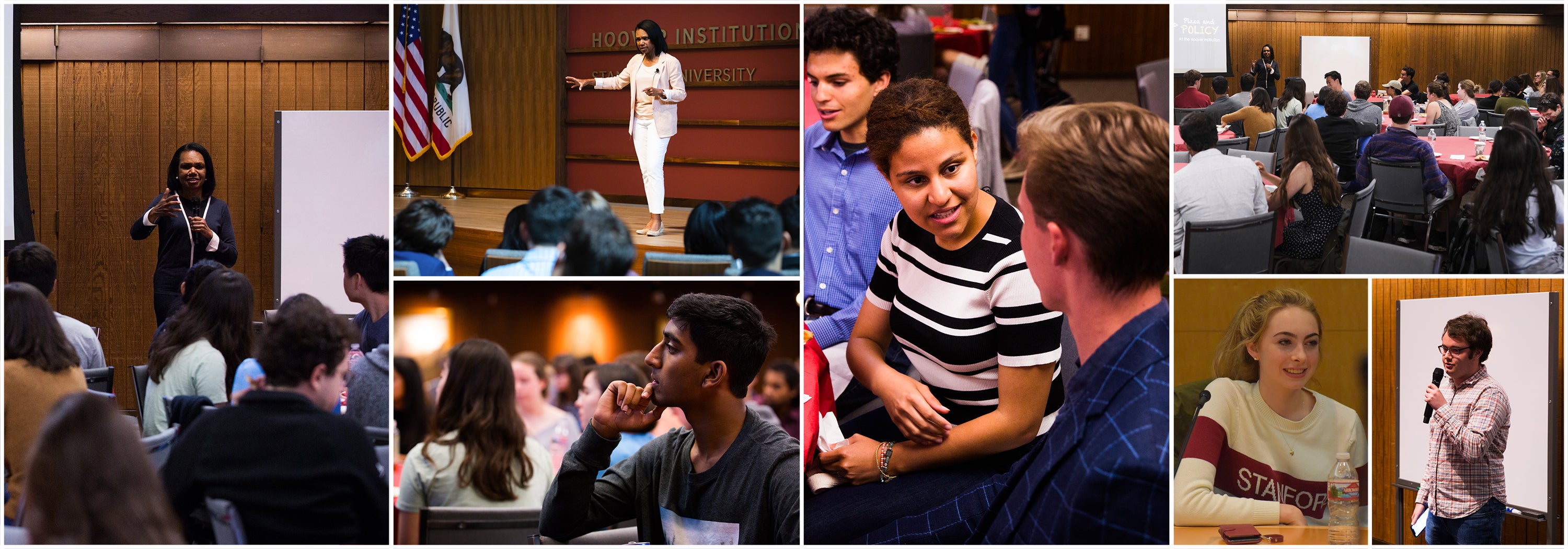
The Hoover Student Fellowship Program (HSFP) offers Stanford students a competitive opportunity to participate in important work at the Hoover Institution across both key research initiatives and organizational areas. The program is a three-quarter-long paid fellowship in which students will be paired in topical areas of their preference with Hoover fellows or staff members.
Students in the fellowship will provide research and operational support, while also benefiting from mentorship and partaking in exclusive programming for the fellowship cohort. Students should expect not only guidance from their mentors and research supervisors, but also a chance to learn more about research, policy, and public affairs from influential leaders at Hoover and beyond. The fellowship will take place in-person throughout the academic year.
Work commitment: 10 hours per week during the October 2026–June 2027 academic year.
Please view the student responsibilities, program eligibility, and project directory below for more information about the program and the research projects available this year.
Applications open: Monday, August 31, 2026
Applications due: Friday September 25, 2026, at 11:59 p.m.
Student responsibilities:
Conduct advanced research and work on special projects for your mentor, often including:
- Executing online research.
- Collecting, synthesizing, and analyzing data.
- Analyzing trends and reporting on current events in each respective fellowship area.
- Writing summaries and memorandums on requested topics as well as proofread and help edit materials.
Assist with operational duties, often including:
- Scheduling and prepping for meetings
- Building and maintaining distribution lists for event and/or research dissemination
- Responding to correspondences on behalf of your mentor or Hoover research initiative
- Crafting marketing materials or project output
- Supporting general Hoover events or programs related to your project
At the culmination of the fellowship, all student fellows will complete a final presentation based on their work in the program. Each participant will present their work to the Director of the Hoover Institution, Hoover Fellows and Staff mentors, and their peers in the program.
Additional: student fellows expected to perform other related duties as requested. The fellowship will be structured to maintain flexibility and tailoring based on staff or fellow needs.
Who is eligible?
-
Fully enrolled Stanford undergraduates—sophomores, juniors, or seniors—of any major
-
Any Stanford graduate student, including students in the GSB, SLS, master’s, and PhD programs
-
Students who can commit to the fellowship position from Autumn 2026 through Spring 2027
-
Students with strong interpersonal, written, and verbal communication skills, with an emphasis on flexibility, attention to detail, and the ability to work efficiently and independently in a fast-paced environment
Questions? Contact Pam Luna at hsfpadmin@stanford.edu for more information.
Program Deadlines
Applications open: August 31, 2026
Applications due: September 25, 2026
Semi-finalist interviews: October 2026
Fellowship begins: Mid-to-late October 2026
Project Directory 2026-27
There are 44 projects available for students to apply to in the HSFP 2026-27 program. Projects are sorted in alphabetical order, and in order to encourage students to apply to projects based on interest, we do not list the names of project mentors in the project directory.
A Wiser World: How Countries on the Wrong Track Turn Themselves Around
What produces wisdom in government? When a country is on the wrong track, what helps it get back on the right one? What are the personal qualities, group dynamics, historical conditions, and other factors that combine to make wise decisions more likely? This project examines key moments in the twentieth and twenty-first centuries when countries made profoundly wise choices. The hope is to extract guidance we could apply today. The student will learn about governmental decision making, historical research, and book manuscript development. The student fellow will be expected to complete research using newspaper databases, online archives, and scholarly articles.
AI & Innovation
The office of the Director of Research oversees research administration and fellow lifecycle management at the Hoover Institution. Through the Hoover Student Fellowship Program, we are seeking an AI & Innovation student fellow to improve operational efficiency using data analytics and AI. This role offers a Stanford student hands-on experience in research administration, budget and event management, data visualization, and the development of practical AI tools that enhance organizational effectiveness, while supporting one of the world’s leading public policy research institutions.
AI and the Changing Information Environment: Rumors, Truth, and Speech
AI is changing how people decide what is true. This project examines how rumors and misinformation get made: by people, by platforms, and by machines. It asks how AI is reshaping the ways people find, consume, and trust information. Chatbots now answer the questions people once asked each other, and they answer instantly, confidently, and often wrongly. The student fellow will support research and case studies that examine how AI is changing the production, quality, and spread of false or misleading information across four areas: elections, vaccines and public health, climate security, and international conflict. An interest in technology policy or law is a plus, as is experience with AI tools; careful research and attention to sources are essential skills.
AI-Enabled Business Process Transformation
Embedded within Hoover’s Business Enablement & Technology Solutions team, the student fellow will conduct applied research on how generative AI can improve and automate administrative processes. Work will include studying existing workflows and AI adoption, engaging with staff to identify challenges, and assessing where AI can improve efficiency and quality. The fellow will prioritize opportunities, design and test AI-enabled workflows using Stanford-approved tools, and evaluate results. Findings will inform solutions and a reusable framework for Hoover while generating broader lessons for organizations embedding generative AI into business processes. Applicants should have strong analytical and problem-solving skills, be comfortable engaging with stakeholders, and have experience using generative AI to improve workflows.
Analysis of California and US Economic Policies
The student fellow will work directly with a Hoover senior fellow to analyze key economic issues in California and at the national level, including housing, homelessness, education, climate, infrastructure, and taxation. Knowledge of Excel and basic statistics is a plus, as is the ability to work with AI and large language models (LLMs).
Bio-Strategies and Leadership
Bio-Strategies and Leadership (BSL) seeks Hoover student fellows to join a multidisciplinary team whose mission is to empower leaders to make timely, well-informed, and effective decisions about biotechnology. Ongoing BSL work focuses on biotechnology innovation, economic and technical competitiveness, national security, biosecurity, and the advancement of biotechnology in ways that strengthen freedom and democracy. Student fellows will contribute original research on these topics and support other essential program tasks. Ideal candidates will be entrepreneurial, driven, and passionate about making an impact. A background in biology or policy is preferred but not required.
Building Renewal Reserve Forecasting: Turning Asset Data into a Capital Budget
Hoover Operations is developing a finance and planning tool to better forecast long-term building renewal needs for Hoover’s two self-funded facilities: the Shultz and Traitel buildings. Using data from the Gordian asset management system, this project will convert existing condition/asset replacement information into a practical capital budget and reserve-funding model that helps answer a core planning question: how much should Hoover set aside each year to sustainably fund building renewal over the next 50 years? The student fellow will support the development of a forecasting tool in Excel or a comparable platform that integrates projected renewal and replacement expenses, current reserve balances, and annual savings targets. The work will include incorporating key assumptions such as inflation, soft costs (e.g., design, management, and contingency expenses), and the database’s market-trend updates (refreshed on a five-year cycle). The student fellow will also translate the model’s outputs into clear visuals and a concise slide deck that explains Hoover’s asset renewal process and summarizes forecast results for Shultz and Traitel. Once completed for these two buildings, the model and summary approach will be designed for replication and potential application to Hoover’s new Washington, DC, building currently under construction.
Digital Content and Audience Engagement
This project requires a student fellow with a strong understanding of social media and digital content creation and an interest in translating complex policy research into engaging and accessible stories that resonate with younger audiences. The work will span channel setup and trend research through production, publishing, and performance analysis. The intent is to inform Hoover about how younger audiences discover and engage with policy content and provide the student fellow with an understanding of how content decisions translate into measurable audience impact.
Digital Publishing Fellow
Hoover Publishing is seeking a student fellow to research and implement best practices for SEO and GEO, helping readers discover Hoover publications online in the age of AI. Key tasks will include updating metadata (keywords, catalog copy, etc.), managing title information, auditing online product pages, and identifying opportunities for improvement. The fellow will also support editorial and production workflows; draft sharp, reader-facing marketing text; explore multimedia and product image placement on retailer listings; and create Amazon A+ Content. This project will entail hands-on publishing work with visible impact on audience reach.
Economics of Colleges and Universities
This project uses large-scale administrative data to study how colleges and universities make decisions in response to changes in labor markets, technology, and the political environments in which they operate. Current projects ask: What returns does society receive from its investment in college? How has politics reshaped the university? And how does knowledge spread from one campus to the next? Work may include assembling and cleaning datasets, running empirical analyses, reviewing academic literature, and drafting research summaries. Ideal candidates should have some programming experience (R or Python preferred), strong attention to detail, and solid research and writing skills.
Emerging Markets & Developing Economies
A student fellow is sought to assist on one or more projects in the area of emerging markets and developing economies. The collaboration aims to develop a framework for informed risk-taking that will enable more private capital to flow in socially beneficial ways to developing world infrastructure projects. Enabled by more transparent returns and risk data, an influx of private capital investment has the potential to reverse decades-long shortages in global infrastructure investment and provide a successful counter to China’s Belt and Road Initiative. The research assistant will be responsible for assisting with research papers on financial and social rates of return as well as streamlining presentations and writing.
Empirical Political Economy of Wars and Information Wars, including AI-enabled, in Eurasia and Beyond
Detect AI-generated content in real-world settings; identify bots on social media; use government statistics to track Russian spending on military recruitment to fight in Ukraine; and analyze audience dynamics for Russian independent news on YouTube. The student fellow will work on one of several empirical or computational social science projects related to digital political communication in both authoritarian and democratic contexts and will also support a small workshop on these issues in early December. Relevant skills may include experience running surveys on Prolific, coding in Python, data analysis or econometrics, or proficiency in Ukrainian or Russian.
Estimating the Worldwide Cost of the COVID-19 Pandemic
This project will assess the costs across countries of the COVID-19 pandemic arising from disruptions to schooling systems. The education component will be integrated with outside research on the costs of morbidity and mortality. The student will be involved in all phases of the analysis that will involve review of existing estimates, collection of relevant data on school closures, school completion, and the like, and estimation of the effects on incomes and economic growth.
Foreign Policy Federalism: States & the Global Commons
This project examines “foreign policy federalism” by analyzing how large US states—New York, Florida, Texas, and California—engage the global commons and build direct relationships with foreign governments, firms, and international institutions. It maps the legal, structural, and fiscal conditions that expand or constrain state autonomy relative to the federal government and identifies where state-federal divergence—including state interests and values—enters a contestable gray zone. Beyond globalization, it considers drivers such as trade, investment, migration, cultural/ethnic affinities, climate and energy, supply-chain security, port and infrastructure policy, and subnational regulatory power. Candidates with strong writing and editing skills are preferred. The student fellow will be expected to help research, write, and edit briefs - sometimes in the form of publishable opinion pieces, where AI use should be leveraged, but limited to research.
Global Security Assistance Initiative
Great powers have long used security assistance—military expertise, hardware, and aid to foreign countries—as an instrument of geopolitics, yet the impact of this assistance remains understudied. This project asks: How do China, Russia, and the United States use security assistance to advance geopolitical objectives? What determines where assistance flows? Does it shape recipients’ policies, bolster repressive governments, or undermine democracy? To answer these questions, we are constructing the first global dataset of Chinese and Russian security assistance in partnership with AidData at William & Mary. The student fellow will train on the China data-collection project before beginning data collection on Russian security assistance. Russian language skills are preferred. The student fellow will train on the China project before beginning Russian data collection. Russian language skills are preferred.
Government Trust and Congressional Representation
This project will involve research assistance on a project examining the decline in trust in the US government. The project analyzes how congressional voting has changed, including the extent to which it corresponds to district versus donor opinion. As part of this project, we are collecting data on public opinion and congressional voting. The student fellow should be familiar with Excel and comfortable with web-based databases. A willingness to help with other projects for the Center for Revitalizing American Institutions (RAI), especially those focused on Congress, would be a plus.
High-Skilled Migration Study
This project involves analyzing high-skilled migrants and the decisions they make. Among other things, we will be using large-scale data analysis to determine why high-skilled immigrants choose to leave America. The ability to use and analyze large datasets is a requirement.
Hoover Dialogue on AI and Technology Governance: Free Speech Program
Technology companies and AI labs develop private rules that shape American public life. These rules determine how AI systems answer politically contested questions, how minors interact with chatbots, when personalization becomes manipulation, and what constitutes appropriate AI use for national security. Hoover’s Program on Free Speech is hosting a series examining how these rules are made and how scholarship can inform them. The student fellow will support the series with research, including preparing background briefs and materials and conducting research and synthesis on each topic. Topics will include AI speech and model behavior; youth and AI; persuasion and scaled manipulation; synthetic media and trust; AI agents; and national security, among others. An interest in technology policy or law is a plus; essential skills include fast, careful research and clear writing.
Hoover History Lab: Global Futures Project
The Global Futures Project is a major initiative led by a historian and geopolitics expert. It serves as a premier research and forecasting program on global statecraft and comprehensive national power.
Human Security Project
The Human Security Project investigates how authoritarian regimes sustain power and how liberty movements can challenge them. By examining historical cases and contemporary strategies across regions and eras, the project identifies opportunities for resistance and develops evidence-based approaches to advance freedom. Student fellows will support the team in producing accessible, pro-democracy resources and educational initiatives, including tools for practitioners and policymakers. Fellows will gain hands-on experience translating research into practical, real-world strategies and tools for implementation. Students with experience in event planning, scheduling, interviewing, and journalism are desired.
India’s Contributions to UN Peacekeeping Operations
This project will involve supporting work on a manuscript under contract with Oxford University Press that focuses on the history and politics surrounding India’s contributions to United Nations peacekeeping operations. Ideal candidates should have an interest in multilateral institutions and Indian foreign policy and be comfortable using digital databases for research.
Indo-Pacific Maritime Strategy
The United States is entering a time of change that will impact the established allied and partner security architecture in the Indo-Pacific. The Hoover student fellow will support a group of interdisciplinary fellows who are focused on using allied and partner relationships to augment warfighting capabilities in the maritime space to deter potential conflict. The fellow will be expected to produce a series of memos and briefs on the changing environment in the Indo-Pacific to inform this work. Experience or familiarity with the US military, the Pentagon, maritime environments, or emerging warfighting technologies would be helpful.
Institutional Programming and Engagement Data Visualization and Graphic Design
The Hoover Institution’s Institutional Programming and Engagement (IPE) team is seeking a student fellow to support data visualization and graphic design that communicates the breadth and impact of IPE’s work. IPE manages a broad portfolio of research programs, fellowships, conferences, policy roundtables, and strategic engagement initiatives involving scholars, policymakers, business leaders, students, and other audiences in the United States and abroad. The student fellow will help translate program data and activity into compelling reports, presentations, infographics, and other informational materials. Ideal candidates will have completed coursework in data visualization or graphic design (e.g., CS 448B, CME 116, DESIGN 170), experience with relevant software, and strong visual design skills.
Judicial Constraints on Executive Power
Are presidents, governors, and other executives constrained by the judiciary in the United States? This book project specifically examines the conditions under which the judicial branch can constrain executive power and whether executive actors anticipate judicial checks when exercising their extensive powers. The student fellow will be responsible for assisting in collecting and cleaning data related to political and institutional factors, at both the federal and state levels, across time. Previous research experience is preferred but not necessary to apply.
Managing Global Political Risk
This book project aims to help organizations and individuals—ranging from global corporations and small business owners to executives, investors, and consumers—understand today’s geopolitical landscape and navigate its risks. Strategic competition with China, resurgent protectionism, and rapid technological change are erasing the boundary between national security and commerce, reshaping markets and warfare, and straining the post-1945 economic and security order. For businesses, there is no longer any such thing as business as usual. Drawing on approaches from national security professionals, the book explores how leaders can improve risk assessment, decision-making, and crisis management. The student fellow will help identify and conduct background research on companies contending with these risks and how they navigate them. The ideal candidate has a demonstrated interest in national security, economics, and/or business.
Markets vs. Mandates for the Environment
This project is seeking student fellows to help with the preparation of a book examining trade-offs of market-driven and regulatory mandate approaches for promoting environmental quality. Whereas mandates rely on politics and administrative rulemaking to assign objectives and command-and-control mechanisms to achieve them, markets rely on incentives of resource owners and entrepreneurs to discover and respond to environmental demands of populations—whether for a stable climate, cleaner air or water, or more biodiversity. Students will gain experience assisting in the development of a manuscript. They may also gain experience researching and potentially coauthoring shorter pieces drawn from the primary research for the book. A background in economics, political science, or environmental science (e.g., biology, ecology, hydrology) is fitting.
Modern Federalist Blog
The Modern Federalist blog launched during the summer of 2024 and features contributions by Hoover fellows who explore contemporary policy issues through the lens of federalism. Specific duties include gathering information for blog posts, reviewing relevant literature, editing longer documents, communicating with guest contributors, and editing and, if appropriate, designing graphics. Excellent written communication skills are required; familiarity with blog platforms and maintenance is preferable but not required. The ideal candidate should have some working knowledge of federalism and political institutions.
Nepotism in a Global Perspective
This project examines the intergenerational transfer of wealth and status via families. We will be examining both historical examples (Han China, Rome, Mamluks) and modern family corporations. Students will build on an existing database and gather historical data. Knowledge of foreign languages is especially welcome, including Chinese, Arabic, and Korean.
NSF SECURE Analytics: Safeguarding the Research Enterprise
American innovation thrives on international collaboration yet needs tools to mitigate and prevent foreign interference in research. SECURE Analytics is a project funded by the National Science Foundation (NSF) that equips researchers to make better, risk-informed decisions about collaboration. We seek a student fellow to support the project’s data collection, analysis, and reporting activities, especially publications on critical dimensions of global science and technology. Preferred qualifications include: advanced reading capability in Chinese or Russian; experience in collecting and analyzing primary source materials; and intermediate to advanced data science skills in R or Python.
Operation Trojan Horse: The World’s Most Enduring Military Tactic
This project involves conducting research for a forthcoming history book on Trojan horse military tactics (destruction in the form of a gift or supplies) from the myths of antiquity to the practices of present-day warfare. The student fellow needs to be an assiduous researcher with an interest in warfare and in history. Knowledge of foreign languages is desirable but not required.
Outreach and Policy Engagement for the Technology Policy Accelerator
This project will strengthen the Technology Policy Accelerator’s social media presence and expand engagement with policymakers, practitioners, and the broader public. The student fellow will help develop a content strategy and editorial calendar; translate fellows’ research, events, and policy recommendations into clear, compelling posts; create basic visual assets; and monitor engagement to refine outreach. Desired qualifications include excellent writing and editing skills, familiarity with major social media platforms and analytics, and experience with Canva or similar design tools. An interest in technology policy is preferred.
Projects on Energy Statecraft
The George P. Shultz Energy Policy Working Group pursues a balanced approach to energy policy. An advanced undergraduate or graduate Hoover student fellow will conduct desk research and provide publication support across current research projects, including a joint Hoover-Stanford Project on Taiwan’s Energy Security and Sustainability; Energy as a Pillar of the US-India Relationship; Maritime Energy Security in the Indo-Pacific; or other US domestic energy policy research projects related to powering AI, nuclear energy, and energy affordability. Fellow work will be guided by expertise or experience with relevant language skills, regional background, policy frameworks, or energy data analytical capabilities.
Project on Nuclear Arms Control and International Security
Rose Gottemoeller is seeking a Research Assistant to provide Russian-language research support on a project related to nuclear policy, arms control, and international security. The work involves identifying, reviewing, and summarizing recent trends and developments on nuclear and security topics, with a focus on U.S.-Russia relations, Ukraine, and implications for European security. Candidates should have strong Russian-language abilities, particularly reading comprehension, along with familiarity with research and media resources in Russia, including state and independent outlets, think tanks, and government sources, as well as Russian-language-speaking communities beyond Russia. An interest in nuclear policy, arms control, nonproliferation, or European security is welcome; relevant coursework or prior research is a plus but not required. Strong Russian- language abilities are required.
Renewing Indigenous Economies
This project is seeking student fellows to participate in research evaluating the causes and effects of economic development on Native American and First Nation land in the United States and Canada. The research will contribute to the Hoover Institution’s Renewing Indigenous Economies program. Research will consist of case study evaluations of tribal economic successes and failures as well as statistical analyses that will evaluate data across Indian Country. Students will gain experience assisting in the development of one or more research papers and may have opportunities to present the research at forums for tribal leaders and students and to audiences of academic faculty. A background in social science—e.g., economics, political science, sociology—or law is fitting, as is a desire to conduct rigorous empirical analysis.
Rethinking Radiation Risk
Ionizing radiation (X-rays, α/β/γ rays) is a carcinogen, and exposure limits shape medical procedures, accident evacuations, and industrial safety standards. These stakes are growing as nuclear power—and possibly fusion—expands, and Executive Order 14300 directs NRC reconsideration. Current standards rest on the linear no-threshold (LNT) model, assuming cancer risk scales linearly with dose, with no threshold. But evidence contradicts LNT (Siegel et al. 2019): cells repair DNA damage, dose rates matter, and high-background populations show no clear excess risk. This project will survey current biological understanding and look at the operational, economic, and regulatory implications of a more sophisticated dose-response curve.
Shaping the Silicon Age
Shaping the Silicon Age (SAGE) examines the semiconductor hardware foundations of economic security at a moment when the supply chains behind advanced computing are concentrated, contested, and increasingly used as instruments of geopolitical leverage. Working with technologists, industry, investors, and policymakers across the United States and allies, the project considers what economic security in this domain concretely requires and translates that into playbooks for corporate and investment strategies, government policies, and manufacturing ecosystems. Student fellows will contribute to research spanning supply chain economics, R&D acceleration, manufacturing ecosystem development, policy design, and capital formation. Applicants from all relevant backgrounds are encouraged to apply.
Stalin’s Terror, 1930–1940
This is a book project that I’ve been working on for a number of years involving Stalin’s “repressions” of the 1930s: terror, purges, executions, deportations to the Gulag, etc. I am looking for a student with excellent organizational skills and some historical background in the subject to help me organize the research materials I have already accumulated for the book.
The Effect of Vocational Education on Student Outcomes: Evidence from Brazil
The state of Pernambuco, Brazil, began creating vocational schools in 2021. Using mixed methods, the project measures the causal impacts of these vocational schools on outcomes. The primary source material is in Portuguese, and we use quasi-experimental methods to measure the impacts.
Wargaming and Crisis Simulation Initiative
The Hoover Wargaming and Crisis Simulation Initiative is a data-centered bridge between traditional wargaming and academia;it runs, preserves, and analyzes games for both academia and policy. Primary responsibilities for student fellows include assisting in the facilitation of games focused on space and AI, analyzing data, curating and categorizing historical wargames for the initiative's collection, conducting oral history interviews, and organizing and hosting initiative events. Foreign language, data analysis, or experience with historical materials is a plus but not required!
What Chinese AI Models Believe: Mapping State Narratives in Open-Source LLMs
Chinese open-source AI models are everywhere. DeepSeek topped the US App Store and its models were downloaded tens of millions of times in months. By some industry estimates, roughly one in five American AI startups now builds on Chinese open-weight models. Research has shown that these models censor, refuse, and repeat state-aligned framing on politically sensitive topics. But the field has no systematic map of the narratives themselves. This project builds that map: a catalog of Chinese state-aligned narratives and the sub-narratives within them, organized by political function rather than topic, with prompt sets that test whether a model carries them. The student fellow will help map narratives across areas such as regime legitimacy, human rights, sovereignty and Taiwan, economic power, and military competition. The fellow will also help run structured tests against leading models. Mandarin is a plus but not required; the essential skills include careful research, precise sourcing, and comfort experimenting with AI models.
What Is AI Deception? Defining a Problem and Building a Research Agenda
This project examines deception in the age of AI and organizes the problem in three ways: models that deceive, whether through error, sycophancy, or strategic behavior; people who use AI to deceive, from impersonation and financial scams to political manipulation; and AI agents that act on our behalf. The project maps each category, asks which harms matter most, and examines how industry and governments are addressing these harms, with the goal of creating policy proposals. The student fellow will support case research, contribute to comparative legal and policy analysis, and help survey industry policies and practices.
When Affirmative Action Was Black and White
The Supreme Court’s decision in Students for Fair Admissions marked a turning point in affirmative action: Asian American students, rather than white students, emerged as the central challengers. This book project explores how that reframing shaped the policy’s downfall and how debates over fairness in admissions connect to a broader set of education controversies. From battles over exam schools to fights over standardized testing to disputes over honors classes and equity, questions about meritocracy run through nearly every level of education. Student fellows will contribute to the book project by reviewing legal and media sources and assisting in the analysis of survey data related to attitudes about education and meritocracy. Candidates with interests in education, politics, or law are encouraged to apply; experience with data analysis (Stata, R, or Python) is a plus but not required.
Who is Winning the New Cold War? The Impact of Great Power Competition
From battleships to television networks, China, Russia, Europe, and the United States have invested in developing instruments for exercising power worldwide. The dimensions of this competition vary from region to region, but the security, economic, and normative interests of these great powers increasingly clash on every continent, especially in key flashpoints such as Ukraine and Taiwan. To date, much scholarship in the West on Cold War 2.0 has focused on identifying American and Chinese intentions and capabilities, as well as, to a lesser extent, those of Russia, Iran, Europe, and Japan. Much less attention has been given to assessing the concrete impact of policies aimed at influencing the type of regime or foreign policy orientations of targeted countries. This project seeks to address that gap by adopting a comprehensive and dynamic approach to studying American, Chinese, Russian, and European tools of influence over time. Students will assist with research and writing tasks. Previous research experience, as well as excellent foreign language skills preferred.
Working Group on Civics and American Citizenship Support
Within Hoover’s Center for Revitalizing American Institutions (RAI), this project addresses America’s dual crises of abysmal civics education and irresponsible citizenship. Via research, communication, and advocacy, it engages participants within Hoover and beyond in deliberation, debate, and pursuit of workable consensus. The student fellow will assist with compiling and editing a periodic newsletter, conducting research on contemporary civics innovations and trends, and providing staff support for meetings of the working group itself. Excellent written communication skills are required; proficiency with basic statistics is a plus but not required.
